


A Cross-Border Cotton Bond: The Success Story of a Pakistani Cotton Breeding Scientist Who Studied in China
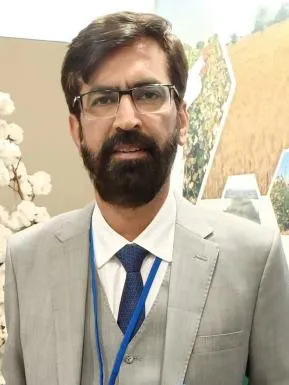
| Name: Muhammad Kashif Riaz Khan | Nationality: Pakistan |
| Duration for studying in CAAS: 2010-2014 | Major: Crop Genetics and Breeding |
| Study Status: Full-time PhD with Chinese Government Scholarship | Current Position: Deputy Chief Scientist and Researcher at the Nuclear Institute for Agriculture and Biology (NIAB), Pakistan Atomic Energy Commission |
Muhammad Kashif Riaz Khan, Born in 1972, from Pakistan, graduated from GSCAAS in Crop Genetics and Breeding in 2014 with a doctoral degree. Currently serves as Deputy Chief Scientist and Researcher at the Nuclear Institute for Agriculture and Biology (NIAB), Pakistan Atomic Energy Commission. He has led and participated in the development of more than 20 new cotton varieties (lines), bred Pakistan’s first interspecific cotton hybrid, and constructed the world’s first high-density interspecific genetic map of Gossypium hirsutum × Gossypium tomentosum. The cumulative impact factor of his academic papers published in international journals is 114.11. In September 2021, he was awarded the Young Scientist Award, and his research team received the Outstanding Achievement Award, jointly presented by the Food and Agriculture Organization of the United Nations (FAO) and the International Atomic Energy Agency (IAEA).
Studying in China: Paving the Way for Academic Growth
Muhammad Kashif Riaz Khan earned his bachelor’s degree from the renowned University of Agriculture, Faisalabad, Pakistan. In September 2010, funded by the Chinese Government Scholarship, he enrolled at the GSCAAS to pursue a doctoral degree in Crop Genetics and Breeding.
As the world’s largest cotton producer, China leads globally in cotton biological breeding and applied research. Recognizing the technical advantages and enormous application potential of biological breeding in cotton improvement, he leveraged the platforms and resources of the State Key Laboratory of Cotton Biology at CAAS to devote himself to research on cotton genomics and molecular breeding. He constructed the world’s first high-density interspecific genetic map of Gossypium hirsutum × Gossypium tomentosum, with relevant findings published in prestigious international journals such as Frontiers in Plant Science. He obtained his doctoral degree from CAAS in January 2014.
When reflecting on his study experience in China, Muhammad Kashif Riaz Khan speaks highly of it: “This is one of the world’s top agricultural academies. I am immensely proud to have earned my doctorate here at CAAS!” He deeply appreciated the support from his teachers and classmates in both studies and daily life, experienced the charm of Chinese history and culture, mastered advanced knowledge and research techniques in cotton genetics and genomics, comprehensively enhanced his academic competence and scientific innovation capabilities, and laid a solid foundation for his future academic career.
“I am extremely grateful to my supervisors, Prof. Wang Kunbo and Prof. Liu Fang. Their professional guidance has made me shine in the field of cotton breeding and genetics!”
Deep Dive into Cotton Breeding: Internationally Recognized Research Achievements
Cotton is Pakistan’s primary natural fiber crop and an important oilseed crop. After returning to Pakistan upon graduation, he continued his research on cotton mutation breeding, molecular genetics and genomics, emerging as Pakistan’s leading cotton breeding scientist.
Against the backdrop of global climate change posing severe challenges to Pakistan’s agricultural development and cotton production, he integrated conventional cotton breeding with research on cotton stress resistance and quality improvement. He developed a series of climate-smart cotton varieties (lines).
These varieties (lines) exhibit moderate to high resistance to Cotton Leaf Curl Disease (CLCuD), a major threat in Pakistan, alongside heat and drought tolerance, high yield and excellent fiber quality. Notably, the new varieties NIAB-KIRAN and NIAB-8788 demonstrate strong adaptability across Pakistan’s diverse climatic conditions, capturing a market share of over 60% in major cotton-growing regions. They have generated billions of rupees in economic benefits for Pakistani cotton farmers. His research has boosted the quality and yield of Pakistan’s cotton crop, offering new strategies and approaches to address agricultural challenges under climate change.
In 2019, as an expert of the International Atomic Energy Agency (IAEA), he led his team to complete the technical assistance project (AZB5002), whose achievements were featured in the IAEA’s success stories of crop mutation varieties.
In 2021, he received the Young Scientist Award, and his cotton research team won the Outstanding Achievement Award, jointly conferred by FAO and IAEA. These represent the highest honors in the global application of nuclear technology in agriculture, recognizing his and his team’s contributions of plant mutation breeding achievements to global food security and sustainable development.
Collaborative Innovation: Boosting China-Pakistan Cotton Science and Technology Cooperation
China’s Belt and Road Initiative has opened new opportunities for China-Pakistan cooperation in agricultural science and technology. In line with the Memorandum of Understanding (MoU) signed between the Ministry of Science and Technology of China and the Ministry of Science and Technology of Pakistan, CAAS established the China-Pakistan Joint Laboratory for Cotton Biotechnology in 2016.
After returning to Pakistan, Muhammad Kashif Riaz Khan actively promoted scientific and technological cooperation and academic exchanges with CAAS. In 2020, he facilitated the signing of an MoU between Pakistan’s Nuclear Institute for Agriculture and Biology and CAAS’s Institute of Cotton Research on the development of high-yield, biotic/abiotic stress-resistant and insect-resistant cotton germplasm resources/varieties. In 2021, he successfully secured a China Ministry of Science and Technology joint project titled Exploration and Utilization of Elite Heat and Salt Tolerant Genes from Tetraploid Cotton in China and Pakistan (Project No. 2021YFE0101200).
In April 2023, he visited the Institute of Cotton Research, CAAS. The two sides agreed to launch joint research on Mining and Utilizing Elite Genes from Tetraploid Cotton Varieties in Pakistan and China to Enhance Heat and Salt Tolerance. Through cotton germplasm exchange, Genotyping-by-Sequencing (GBS), Single Nucleotide Polymorphism (SNP) analysis, Genome-Wide Association Studies (GWAS) and transcriptome analysis, they aim to jointly advance breeding for biotic and abiotic stress resistance.
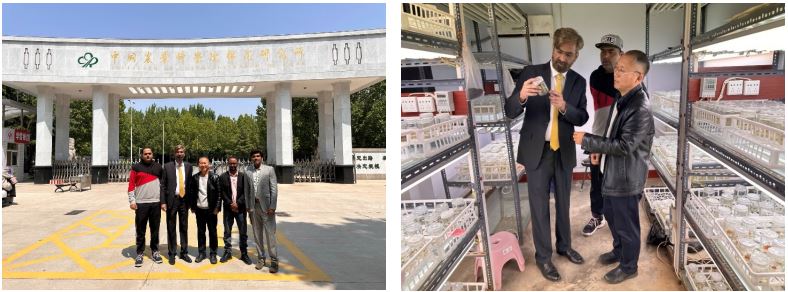
He also contributed to the compilation of the English monograph Breeding Cotton for Heat Tolerance, edited by the Institute of Cotton Research, CAAS. In 2023, as a milestone outcome of years of bilateral cooperation, he officially released the climate-smart cotton variety NIAB-512.
As the Belt and Road Initiative advances with high quality, China-Pakistan cooperation in cotton science and technology will yield even more fruitful results.